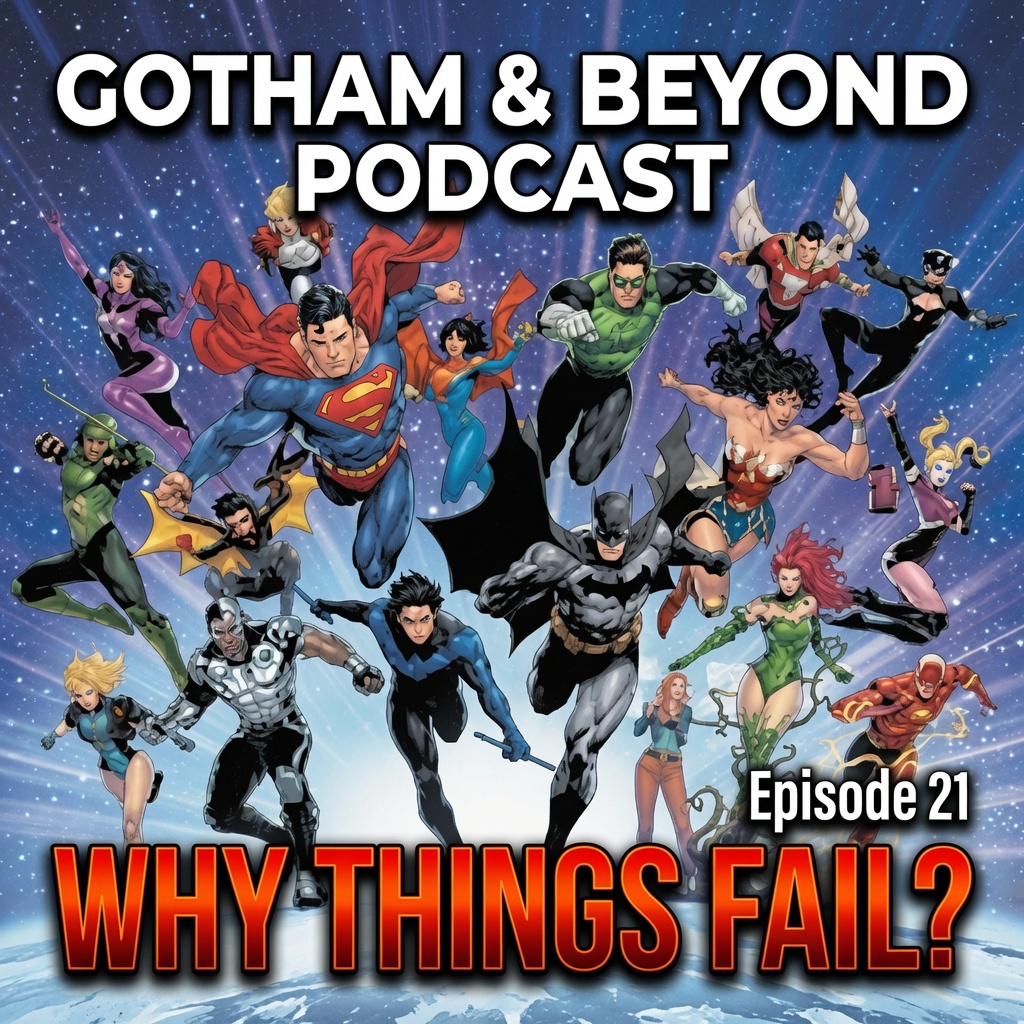
Why do so many superhero campaigns start strong and then slowly fall apart?
In this episode of Gotham & Beyond, we examine four of the biggest reasons DC Heroes campaigns fail. From overusing famous NPC heroes and escalating threats too quickly, to power imbalance at the table and the temptation to build characters that overshadow everyone else, these are problems that many Game Masters eventually encounter.
Project Prometheus feels like one of those adventures Mayfair probably should not have been able to fit into thirty pages, yet somehow they did anyway. Reading through it now, you can see early DC Heroes trying to figure out what superhero roleplaying could really be. This is not a simple "fight the villain in a warehouse" kind of module. It throws giant eagle attacks, blackouts, secret government investigations, Mediterranean pursuit scenes, ancient mythology, super-science, and a literal Minotaur into the same story and somehow keeps moving forward.
Messy? Absolutely. But boring? Never.
What surprised me most revisiting it was how investigation-heavy it actually is.
The module wants heroes gathering information, chasing leads, talking to contacts, and slowly uncovering a larger conspiracy. The action scenes are big and loud, but the connective tissue is detective work and escalation. That still holds up today. If I ran Project Prometheus now using DC Heroes 3rd Edition, I would mostly clean up presentation and expand some character moments, but I would leave the core structure alone. The strange mythology-meets-technology angle gives the adventure a personality a lot of modern superhero scenarios are missing. It feels unapologetically comic-book, and honestly, that may be why it still works.
Episode 19 takes a look at King of Crime, one of the early DC Heroes modules from Mayfair Games, and this one wastes no time getting the city into trouble. Central City is under pressure almost right away, with the Secret Society of Super-Villains making coordinated moves that leave the heroes scrambling from one crisis to the next. That is one of the big strengths of the module. It understands momentum. It gives you a city in trouble, a villain team with personality, and a steady climb in tension that feels very much like an old comic book arc. Instead of one flat plot, you get a string of crimes, public danger, and rising stakes that keep the adventure moving.
This episode of Gotham and Beyond looks at Blood Feud, an early DC Heroes module that still has a lot to teach. I talk about why the adventure works, how it builds pressure, and how you can adapt it for your own custom heroes without needing the exact team it was written for. If you like old superhero modules, city-based trouble, villain teams, and adventures with good bones, this one is worth a second look.
A lot of villains in superhero games fall apart because they get built backwards. You start with powers, numbers, and combat tricks, then try to figure out who they are after the fact.
You look at that cover and you already know what kind of story this is going to be. Not clean. Not heroic in the shiny sense. This is street-level pressure. People getting grabbed, dragged, hurt. No speeches. Just force.
Super Strength is obvious. Flight is obvious. Heat Vision, Energy Blast, Invulnerability, all of that makes sense the second you read it. You know what those powers do. You know why they matter. They are loud powers. Clean powers. Comic book powers in the most direct way possible.
Episode 14 takes a look at In Hot Pursuit, a fast-moving DC Heroes module built around pressure, momentum, and constant reaction. This time, the focus is not just on the adventure itself, but on how you can take a module written with specific superheroes in mind and make it work for custom characters at your own table.
You read something like Countdown to Armageddon and your first thought is, “This is for Superman.” And yeah… it is. The whole thing is built around him being everywhere at once, solving disasters while Brainiac is pulling strings behind the curtain.
I got an email from a GM running DC Heroes 3rd Edition.
A player activates Invisibility every single phase. Wins initiative. Attacks first. Turns it back on. Repeats. The villains never get a real shot at him. Every fight becomes the same thing.
Omni Gadgets appear on pages 117 and 118 of the DC Heroes core book. They look simple at first glance. One AP rating. One use. Then you read deeper and realize they carry the whole idea of a utility belt. These devices let a hero pull out a single tool that becomes exactly what the moment needs. Not through hand waving. Through a clear rule.
A mid 90s DC Heroes 3e campaign recap. Freight yard at dawn as a serpent
cell tries to snatch a STAR Labs weather core. I talk about the AP
countdown, fast Action Table checks, rotor wash tricks, and Hero Point
rewards. Clean, non lethal, quick pacing.
Sometimes the rules give you everything you need. Other times, you have to break them a little. Pushing Automatic Actions in DC Heroes 3rd Edition is exactly that. It’s the moment your hero digs deep, burns every ounce of strength, and tries something they should not be able to do.